Center for American Progress

5 Hidden Ways the Government Rigs the Market in Favor of Fossil Fuels
Report

5 Hidden Ways the Government Rigs the Market in Favor of Fossil Fuels

While renewables have received scrutiny from the Trump administration and congressional Republicans over subsidies, the administration’s narrative hides how fossil fuel industries reap the benefits of a distorted market that has made Americans pay more for polluting fossil energy for decades.

In this article

Introduction and summary

For more than a century, American taxpayers have paid oil, coal, and gas industries to extract and pollute.1 From special tax breaks to ignoring the impacts of pollution, companies have been extremely successful in pushing the costs of an expensive industry onto the public.2 Yet the Trump administration has almost exclusively attacked renewables subsidies while doubling down on fossil fuels. In April 2025, Secretary of Energy Chris Wright said, “Subsidies are meant to drive prices down and boost supply. But subsidizing wind and solar has done exactly the opposite. … It’s time to stop subsidizing such insanity in perpetuity. If sources are truly economically viable, let’s allow them to stand on their own, and stop forcing Americans to pick up the tab if they’re not.”3

This field is hidden when viewing the form

Default Opt Ins

This field is hidden when viewing the form

Variable Opt Ins

This field is hidden when viewing the form

In reality, coal, oil, and gas industries have reaped the benefits of being subsidized for much longer.4 The federal government has long provided the fossil fuel industry with direct financial subsidies, cheap and plentiful access to land for drilling, and more predictable permitting—and has let companies get away with pollution harms. Analysis by the Center for American Progress finds that fossil fuel companies receive government subsidies at every step in the production process that hide the true cost of fossil fuel operations. Oil, gas, and coal have received $549 billion in direct tax subsidies since these industries were created more than 150 years ago.5 That is nearly three times the amount that the renewable energy industry has received in subsidies over the same period. Additionally, the fossil fuel industry pays almost 40 percent less for federal lease rent than the solar industry’s median per-acre rent and twenty times the amount in production fees. These taxpayer-funded benefits create the very market distortion that Wright claims to oppose, boosting corporate profits without providing meaningful benefits to consumers.6

The narrative being pushed by Wright and others—that renewables are not economically viable without subsidies—is false, but its harms are real. The Trump administration and congressional Republicans have used this reasoning to unveil increasingly draconian policies on renewable energy, including stripping away tax credits and blocking federal permitting for solar and wind.7 Contrary to critics’ claims, these sources of clean energy are providing major benefits to consumers’ wallets and their health. Moreover, since 2009 the costs of wind and solar have fallen by 55 percent and 84 percent, respectively, making renewables the cheapest source of energy even without subsidies.8

President Trump’s pro-oil and -gas and anti-renewable policies make good on his promises to fossil fuel executives, who donated millions to Donald Trump’s 2024 campaign after hearing assurances that he would repeal environmental regulations and expand access for drilling on public lands.9 The fossil fuel industry spent more than $150 million to lobby the federal government in 2024, including for expansion of tax deductions for oil and gas exploration and other priorities that often come at the expense of renewable energy.10 But the Trump administration’s actions to block support for renewables, while continuing to boost funding for fossil fuels, will have major consequences for energy affordability, reliability, and pollution. While subsidies are often advertised to help reduce energy costs, research suggests that these industry-specific corporate handouts primarily go toward increasing company profits, with little impact on jobs or energy prices.11 By tilting the playing field, the Trump administration is actively choosing fossil fuel “winners,” increasing costs for American taxpayers and exposing them to the risks of a less resilient, polluting energy system.12

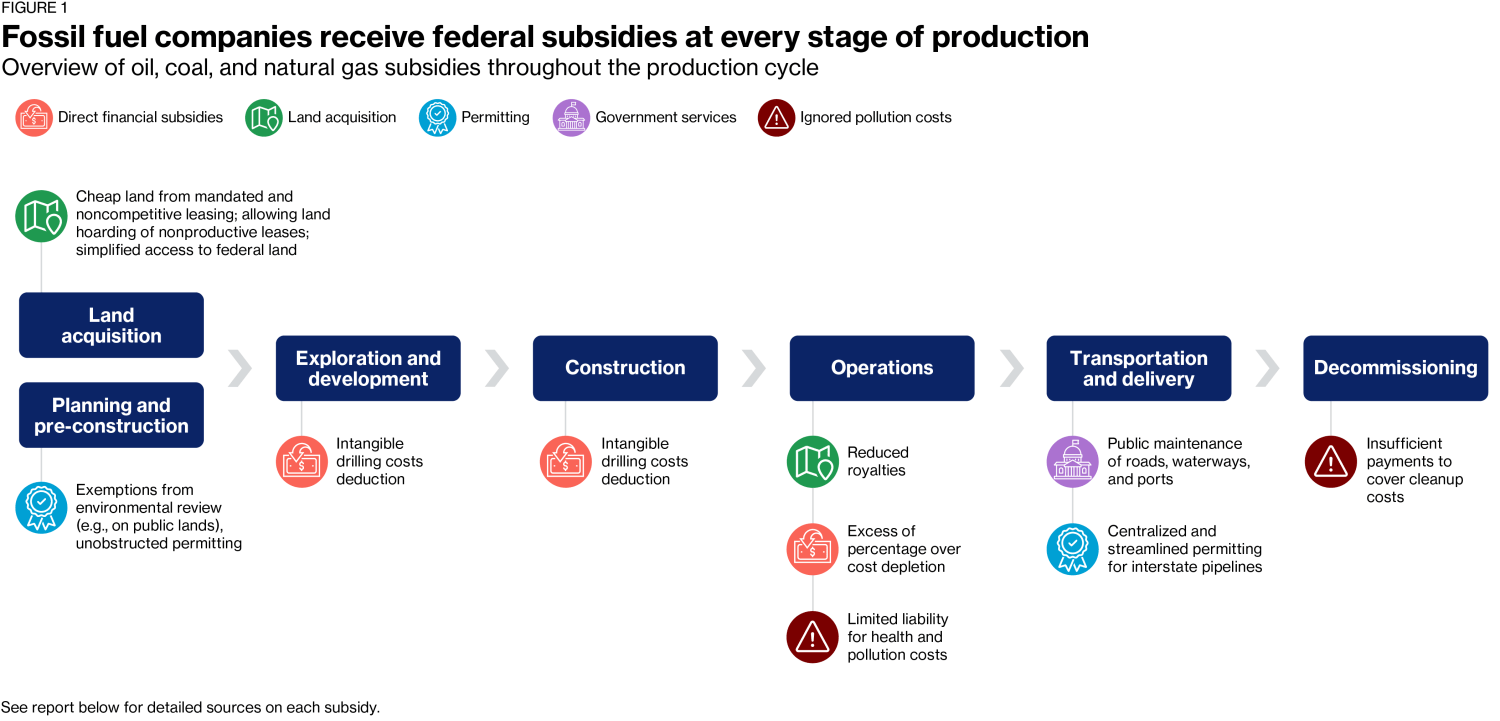
Coal, oil, and gas industries receive several types of subsidies throughout the production process. This report compares federal subsidies for fossil fuels with those for renewable energy, using analysis of both historical financial data and federal policies that affect energy development. In this report, fossil fuel subsidies are split into five major categories:

  • Direct financial subsidies, including tax credits and deductions, special accounting methods, and direct payments from taxpayers to companies
  • Land acquisition, including mandated leases of public lands, reduced royalties on federal lands paid to U.S. taxpayers, and cheaper per-acre costs
  • Permitting, including actions to streamline and fast track permits while permits for renewable energy projects are given hurdles or blocked altogether
  • Government services, including maintenance of roads, waterways, and ports, as well as use of the military to secure overseas interests
  • Ignored pollution costs, including absolving fossil fuel companies of the costs of cleanup and the health impacts of pollution

Direct financial subsidies

U.S. fossil fuel direct subsidies are estimated at $29.4 billion annually,13 enough to pay for the annual utility bills of 17.2 million Americans.14 The term “direct subsidies” refers to policies that lower costs for companies, which can include special tax credits and deductions, as well as accounting methods reserved for the fossil fuel industry. In particular, the industry benefits from specialized accounting methods that allow companies to understate profits or overstate expenses that can be written off, reducing their tax burdens.15 Some of these policies have been in place for more than a century, making it difficult to quantify the true amount taxpayers have spent to support the fossil fuel industry cumulatively.16 A study of 16 of the most impactful subsidies finds that, depending on the price of gas and oil, 75 percent to 96 percent of the subsidies’ value goes directly to increasing companies’ profits, not to increasing supply.17 This is because many of the projects were already profitable to begin with and would have been developed even without subsidies.

For example, Congress established the “intangible drilling costs” tax provision in 1916. This rule allows oil and gas companies to immediately deduct the costs of drilling a new well rather than spread out the deduction over the many years the well will be used.18 This allows companies to pay less in taxes up front and recapture their investments faster—a privilege that has only been sporadically available to other industries. Congress originally created this provision when oil was a riskier business, but the scope of the subsidy has since expanded.19 Today, it covers between 70 percent and 100 percent of non-equipment drilling costs20 and costs taxpayers around $1.6 billion each year.21

Federal policies also allow the fossil fuel industry to understate profits for tax purposes. Through an accounting method known as the “excess of percentage over cost depletion,” independent oil companies can deduct 15 percent of their taxable income.22 Ostensibly, this tax deduction is meant to account for the decreasing property value of the land as oil and gas are extracted. However, since companies are allowed to deduct 15 percent of their income for as long as a given well is producing, these deductions can exceed capital costs, which include the amount spent on acquiring property, equipment, and drilling wells.23 This industry handout is estimated to cost taxpayers $600 million to $1 billion each year.24 When such wells are located on public lands, taxpayers essentially are paying for companies to deplete the resources of lands that belong to the public.25

The largest federal tax breaks for fossil fuel companies, however, are not even for domestic production.26 The so-called “dual capacity taxpayer” provision allows U.S. fossil fuel companies to claim outsize foreign tax credits at home. While most companies are allowed to claim credits for income taxes paid to foreign governments, the oil and gas sector is allowed to claim credits for nontax payments, including royalties for drilling.27 Across all sectors, this tax break costs taxpayers a massive $3.5 billion to $7.2 billion annually. The oil and gas industries are the primary beneficiaries of this provision, although a lack of disaggregated data makes it difficult to quantify exactly how much goes to these companies specifically. Additionally, the establishment of a global corporate minimum tax in 2017 further subsidized the fossil fuel industry by completely excluding income from foreign drilling from the tax.28 Because these policies apply only to companies with foreign operations, their benefits are highly concentrated among a small handful of huge, ultra-profitable firms.

Historically, subsidies are intended to help emerging industries provide services while they may not yet be profitable. For example, solar and wind are relatively new technologies, gaining commercial widespread use beginning only around the turn of the 21st century. The main U.S. clean energy tax credits, the investment and production tax credits (ITC and PTC, respectively) were designed with expiration dates to spur the innovation and deployment of these technologies that allow them to come to market and bring down costs, before phasing out.29 Ultimately, these credits have expired and been extended on multiple occasions, making it difficult for developers to predict whether they will be able to rely on federal financial support for future projects.

Together, the cumulative amount fossil fuels have received from the federal government since 1918 totals an estimated $549 billion—nearly three times what renewables have received at $195 billion.

In comparison, the biggest subsidies for fossil fuels began to appear in the 1910s to support the budding industry, but these subsidies never phased out.30 They have persisted and, in some cases, expanded, despite oil, gas, and coal being highly mature, entrenched industries. The true costs of 100-plus years of direct and indirect subsidies, which made the fossil fuel industry the dominant form of energy in the first place, are difficult to accurately quantify due to a lack of transparency and reliable historical data from federal government sources.31 To estimate direct tax expenditures for each energy type, CAP combined Joint Committee on Taxation (JCT) data, available from 1978 to 2025, with estimates from the Pacific Northwest National Laboratory (PNNL) of tax incentives for oil, coal, and gas between 1918 and 1978. Together, the cumulative amount fossil fuels have received from the federal government since 1918 totals an estimated $549 billion—nearly three times what renewables have received at $195 billion.

While historical comparisons clearly show greater subsidies for fossil fuels given the industry’s longer lifespan, other research has shown that fossil fuels also beat out renewables when comparing subsidies over equivalent time periods. One study estimates that during the first 15 years of the renewable energy industry, which are considered critical for technological development and commercialization, oil and gas companies received nearly five times the amount of government support compared with renewables.32 Even when ignoring the longevity of the fossil fuel industry and associated subsidies, the playing field still is tilted in its favor.

Finally, the existence of subsidies for fossil fuels has been reliable and predictable for the industry for the past 150 years. Meanwhile, renewal of the ITC and PTC have been in flux since their conception and have expired multiple times.33 The Big Beautiful Bill (BBB) rescinded a long-term reauthorization of these credits, creating a challenging and uncertain environment for clean energy developers to plan and secure funding, while century-old subsidies for oil, natural gas, and coal were strengthened.34

The Big Beautiful Bill stripped support for renewables while doubling down on subsidies for oil and gas

The BBB, passed by Congress in July 2025, established $39.7 billion in new subsidies for fossil fuels over the next 10 years.35 The bill also mandates lease sales and other benefits for fossil fuels while making it more difficult to develop renewables.36

Land acquisition

A significant portion of American energy production occurs on federal land, enabled by lease agreements between energy developers and the federal government.37 The process of authorizing energy production on federal land is complex for renewables and can represent a form of indirect subsidies provided by the federal government to energy companies. The result is an uneven system that stunts the build-out of renewables on public lands while fossil fuel extraction proliferates. Just 4 percent of currently operating renewable energy generation occurs on public lands, compared with 11 percent of natural gas, 12 percent of oil, and 40 percent of coal production.38

Oil, gas, and coal

Oil, gas, and coal companies benefit from predictable and frequent opportunities to competitively bid on federal land leases. Due to changes made by the BBB, leases for oil and gas development on federal land must be offered every quarter, with advance notice of the tracts available.39 Due to recent changes in the BBB, the Bureau of Land Management (BLM) is required to offer for auction within 18 months of nomination all available parcels of interest nominated by companies, a policy shift that removes all federal discretion over oil and gas leasing.40 The BLM generally awards leases to the highest bidder through a competitive lease sale.41 However, through a process revived by the BBB called noncompetitive leasing, any leases that did not receive bids are offered the next day to the first applicant at a much lower cost. Even if oil and gas companies leave the land undeveloped, acquiring large amounts of cheap land allows them to pad their assets to appear more attractive to investors while preventing that land from being used for conservation, recreation, or other beneficial uses.42 From 2001 to 2020, 28 percent of all leased federal land was issued through noncompetitive leases.43 On average, noncompetitive leases cost $562 less per acre, which amounts to a 99.5 percent discount.44 Moreover, only 1 percent of noncompetitive leases generated royalties in their first 10 years, proving that these leases are not a meaningful source of revenue for the federal government.45

Further, lease rental costs for oil and gas are both low and predictable, allowing oil and gas companies to easily project out payments and expenses for their projects. The terms of payment are fixed at a cost of $3 per acre for the first two years, $5 per acre for years three through eight, and $15 per acre for the remaining years on the lease.46 For years, advocacy groups and government officials alike have called for raising the royalty rate for oil and gas development on federal lands, which could generate hundreds of millions of dollars in revenue for federal and state governments at a negligible cost to the industry.47 The Inflation Reduction Act raised the royalty rate from 12.5 percent to 16.67 percent in 2022, but the Trump administration quickly reverted it.48 Notably, the royalty rate is well below the market rate compared with oil and gas development on state lands, with state royalty rates ranging from 16.6 percent to 25 percent.49 (apart from Alaska, see Figure 4) For example, New Mexico recently raised the royalty rate for oil and gas development on its state lands to 25 percent. The move was followed by two record-breaking lease sales for state revenue, bringing in $250 million for the state in just one sale and undermining industry claims that higher royalty rates dissuade oil industry investment.50

For coal, the leasing process is similarly predictable and even cheaper, with an annual rent payment of $3 per acre and a royalty rate of just 7 percent on federal lands.51 The BBB lowered the royalty rate from 12.5 percent and restored federal leasing, including requiring an increase in the acres of public land available for coal leasing, in an attempt to slow coal’s sharp decline.52 Yet despite this support, coal remains one of the dirtiest and most expensive forms of energy, and trying to save the industry is a losing battle that is harming taxpayers.53 In fact, in the most recent federal coal sale, the highest bid worked out to just a fraction of a penny per ton.54 Even though this bid was ultimately rejected, the failure of this coal sale demonstrates the BLM’s willingness to use significant resources to subsidize a dying industry.

Solar and wind

In contrast, solar and wind projects are not only hindered by burdensome requirements but are actually dependent on fossil fuel leasing. Before it approves a solar or wind project, the BLM is mandated to have held an oil and gas lease action within the previous 120 days and have auctioned a minimum acreage of oil and gas leases in the previous year.55 This means that if the BLM does not hold an oil and gas lease sale, or not enough acres are leased for oil and gas, no wind or solar leases can be secured.56

The leasing process for wind and solar developers is also much less predictable and more burdensome than for oil, gas, and coal. Unlike the standard leasing process for oil and gas, solar developers must obtain a federal “right-of-way” or lease through different routes, each of which has different requirements.57 For example, the BLM offers rights-of-way for solar developments through competitive sales.58 In 2024, the BLM removed the requirement for mandatory competitive lease sales for rights-of-way, leaving frequency of sales up to the BLM59—unlike oil and gas sales, which are held quarterly by federal mandate.60 Developers may submit nominations for lands to be included in a competitive process, but unlike the oil and gas process, these tracts are not guaranteed to be subsequently auctioned at all—let alone at a 99.5 percent discount.61 An alternative to competitive lease sales is the application process, but applications for a right-of-way lease or grant to develop a solar project have numerous requirements and the BLM retains significant discretion over the right-of-way and land access even once the application is approved.62 

Rents and fees for solar and wind leasing have also undergone recent changes. Under the BBB, acreage rent rates are determined through a complex formula using a per-acre rate that changes annually.63 For example, before production starts, a solar farm with a right-of-way on public land in Montana in 2025 would pay 2.7 times as much per acre as an oil or gas company, which would pay a flat rate of $3 per acre for the first two years.64 The $3 rate is constant for fossil fuel industries leasing federal land, while for renewables, this rate is calculated individually for each state.65

Once production begins, solar and wind developers are required to pay the greater of either the acreage rent or a capacity fee, calculated as 3.9 percent of the project’s annual gross proceeds from the sale of electricity from the project.66 Assuming an average revenue of $58.81 per megawatt-hour (MWh), this capacity fee comes out to roughly $17.24 per million British thermal units (MMBtu). In comparison, in 2024 the BLM received $6.6 billion in royalties from all oil- and gas-producing leases on federal lands, which translates to a fee of approximately $0.85 per MMBtu—meaning solar developers pay twenty times as much.67 If oil and gas companies paid as much as solar companies for their energy production, the federal government would receive an additional $127 billion in revenue. This massive cost differential contributes to a system that overwhelmingly favors fossil fuels instead of renewables on public lands.

Fossil fuel subsidies prop up expensive energy

One common argument for preserving fossil fuel subsidies is that they keep energy and transportation prices low, and that removing them would make those costs unaffordable.68 But studies suggest that eliminating federal oil and gas subsidies would have a negligible impact on consumer prices,69 as the vast majority of federal subsidies’ value flows to excess profits for oil and gas companies.70 Moreover, any increase in fossil fuel production caused by subsidies would increase consumer costs in other places, such as spending to address health concerns related to pollution.71 Additionally, major oil and gas companies including ExxonMobil and Chevron pay next to nothing in taxes, meaning that despite being heavily subsidized by taxpayer dollars, the vast majority of company profits are going to shareholders rather than back to average Americans.72

Instead, these industry-specific subsidies distort which energy sources are actually the cheapest. For example, in 2023, 99 percent of coal plants were more expensive to continue operating than to replace with wind or solar, but now many are currently being kept open by emergency orders from the Trump administration.73 Meanwhile, renewable energy would remain affordable even if subsidies were removed.74

Another often-used argument is that subsidies are necessary to support jobs in the oil and gas industry. This ignores growing employment from renewables industries. Jobs in clean energy grew 32 percent faster than the rest of the energy sector from 2022 to 2023.75 Additionally, oil and gas jobs in the United States have been decreasing despite oil and gas production increasing.76 Oil and gas employment is 25 percent lower than 10 years ago even as production levels reached record highs, partially due to remote work technology.77

Permitting

Another way the U.S. government boosts fossil fuels is through unbalanced permitting policies. Energy projects are required to obtain various permits from federal agencies, from compliance with the Clean Air and Clean Water acts to permits from the Federal Aviation Administration to avoid interference with aircrafts. The Trump administration has weaponized this process to slow renewable development: All federal solar and wind permits must be reviewed by the secretary of the interior,78 and federal wind permits remain paused after an executive order was issued early in 2025.79

Even before recent administrative actions, the government has created significant permitting loopholes for fossil fuel industries. One example is a National Environmental Policy Act exclusion for oil and gas that allows expedited permit review on public lands but does not apply to clean energy projects.80 Recently, the administration also sought to avoid environmental review and public comment for oil and gas drilling.81 Additionally, significant imbalances exist in permitting the infrastructure needed to transport energy: While it takes an average of 18 months82 to permit an interstate natural gas pipeline, it takes an average of 4.3 years—and, in some cases, up to 11 years—to permit interstate power lines that are needed to transport electricity from clean energy.83 This discrepancy exists despite their similarities as large, linear infrastructure that spans states and requires complex planning.

Government services

In addition to monetary subsidies, the U.S. government provides numerous services that reduce costs for fossil fuel companies. These companies benefit from heavily subsidized use of federal waterways, roads, and ports while paying fees that fall short of covering maintenance and infrastructure costs.84 U.S. taxpayers also bear the burden of military operations that protect overseas oil and gas interests85 and secure shipping routes, such as in large-scale deployments off the coast of Venezuela to secure “cooperation” on oil extraction.86 The cumulative value of these services is difficult to quantify precisely but may amount to tens of billions of dollars annually.87

Social and environmental costs

Lastly, fossil fuel companies are largely absolved from paying for pollution and other costs to public health and the environment. From exploration to production, oil, gas, and coal pose significant risks to the environment and to human health.88 Yet the industry often benefits from loopholes and insubstantial federal requirements to shoulder the consequences of fossil fuel production.89

For example, oil and gas companies are required to pay bonds to cover decommissioning costs, but the bonds would cover less than 6.5 percent of the estimated actual cost to clean up oil and gas wells on federal lands.90 Cleanup and reclamation of these wells would cost between $2.9 billion and $17.6 billion by one estimate—an order of magnitude more than what is currently held in bonds—leaving taxpayers to shoulder the cost burden of cleaning up the industry’s mess. This pushes costs and liabilities onto state governments and taxpayers, who often cannot afford the price of remediation.91 This has resulted in more than 2 million abandoned wells across the country, creating massive and long-term health, environmental, and financial risks to local communities.92

In another example of absolving fossil fuel companies from cleanup, extraction of leftover rock, sludge, and chemicals used for processing is exempted from certain federal hazardous waste rules.93 This exemption treats the solid waste as nonhazardous, despite the fact that it is often contaminated with lead, arsenic, or radioactive chemicals. This contamination complicates remediation and spikes costs for states to clean up oil and gas projects. By one estimate, this exemption reduces the cost of each well by $60,000, padding fossil fuel companies’ bottom lines while posing pollution threats to communities.94

Well cleanup, solid waste extraction, and other implicit subsidies for fossil fuel companies account for an estimated $62 billion per year in the United States.95 Given the small number of fossil fuel producers, individual companies profit massively from the loopholes that absolve them of the responsibility of these externalized costs. Implicit subsidies make up 18 percent of the median natural gas and oil producer’s net income, and some companies benefit from more than $1 billion in subsidies per year.96 For the majority of coal producers, the financial benefit from implicit subsidies outweighs these companies’ net income.

The largest subsidy—and perhaps most challenging to quantify—is the impact of pollution on human health. The burning of fossil fuels causes negative health impacts—such as increasing risk of asthma, cancer, and premature death—the costs of which are pushed from fossil fuel companies onto the general public.97 In 2023, the International Monetary Fund estimated that eliminating fossil fuel subsidies globally would avoid 1.6 million premature deaths annually and raise government revenues by $4.4 trillion.98

Renewables benefit both the electric grid and consumers

Despite claims otherwise, solar and wind energy are reliable and cost-competitive.99 Across the United States, renewables support large grid demands without blackouts or cost increases.100 Renewables also promote reliability by providing resilience from international markets, while oil and gas prices are closely tied to global fluctuations.101 In addition, fossil fuels are prone to failure during periods of extreme heat and cold, while building renewables can help the grid be more resilient during extreme weather events.102

Renewable energy is also increasingly cost-competitive, even without subsidies. Utility-scale solar and onshore wind have an average levelized cost of $58/MWh and $61/MWh, respectively, compared with $78/MWh for gas combined cycle, a form of energy production that combines a gas turbine with a steam turbine,103 and $122/MWh for coal.104 Meanwhile, fossil fuel projects remain heavily reliant on subsidies. A study in 2017 found that at a price of $50 per barrel, nearly half of new, yet-to-be-developed oil projects would not be profitable without tax preferences and subsidies.105

Conclusion

Despite claims to the contrary, fossil fuels have received far more in subsidies over the course of American history than renewables. Even though oil, gas, and coal are highly mature industries, they will still receive tens of billions of dollars in annual federal subsidies in the coming years, in part as a result of intense and expensive lobbying.106

These effects are compounded by other factors that tilt the playing field, including beneficial land-leasing policies, permitting requirements, and additional barriers experienced only by renewables. The Trump administration has boosted support for expensive fossil industries and stripped cheap, clean energy of needed support, all while decrying solar and wind subsidies. This bad faith focus on relatively small clean energy subsidies conceals the actual impact of these policies: preventing affordable, rapid-to-deploy electricity at a time of record energy demand and rising costs for Americans. Secretary Wright was right when he said, “It’s time to stop subsidizing such insanity in perpetuity”—it is the energy source he got wrong. Policymakers must stop forcing Americans to pick up the tab for dirty fossil fuel production that is harming Americans’ health and environment.

Acknowledgments

The authors would like to thank Jenny Rowland-Shea, Nicole Gentile, Lucero Marquez, Kendra Hughes, Mark Haggerty, Shannon Baker-Branstetter, Corey Husak, Cindy Murphy-Tofig, Chester Hawkins, Bill Rapp, Mike Williams, Frances Colón, Kalina Gibson, Trevor Higgins, Bianca Serbin, Anh Nguyen, and Allison McManus from the Center for American Progress for their contributions to this report. They would also like to thank Zorka Milin, Thomas Georges, Meghan Pazik, Alan Zibel, Pete Erickson, Justin Meuse, and Gregg DeBie.

Methodology

Direct government subsidies were estimated using JCT data from 1978 to 2025 of tax expenditures for oil, gas, coal, wind, and solar for both corporations and individuals. The included tax subsidies are the following:

Renewables (solar and wind)

  • Credits for electricity production from renewable sources
  • Investment tax credit
  • Credit for investment in advanced energy property
  • Credit for holders of qualified clean energy bonds
  • Modified Accelerated Cost Recovery System (MACRS) (renewables)
  • Residential energy credits
  • Alternative conservation and new technology credits
  • Business energy credits
  • Advanced manufacturing production credit

Fossil fuels (oil, natural gas, and coal)

  • Coal production credits
  • Credits for investments in clean coal facilities
  • Amortization of geological & geophysical expenditures
  • MACRS (natural gas)
  • Excess of percentage over cost depletion (fuels)
  • Expensing of exploration and development costs
  • Expensing of the cost of property used in the refining of liquid fuels
  • Tax credit for enhanced oil recovery costs
  • Tax credit for production of nonconventional fuels/alternative fuel production credit
  • Exception from passive loss limitation for working interests in oil and gas properties
  • Capital gains treatment of royalties on coal

For years when the JCT did not publish tax expenditure data (1985, 2013, 2021), the previous year’s estimates were used. Tax expenditure values reported by JCT as less than $50 million were excluded from our total. Where estimates were broken out by energy type, tax expenditures for solar and wind specifically were included, and other types of clean energy (geothermal, nuclear, etc.) were excluded. For certain tax credits—including credits for investment in advanced energy properties, residential energy credits, alternative conservation and new technology credits, and business energy credits—tax expenditures applied to non-solar and non-wind projects, but energy-specific values were not disaggregated in JCT data for at least a part of their lifespan. As a result, this analysis likely overestimates the value of these specific credits. Lastly, provisions including dual capacity taxpayer treatment and the exemption for foreign oil and gas extraction from the global corporate minimum tax could not be included since they are not reported in JCT estimates as energy-specific expenditures, despite the disproportionate benefits to oil and gas companies. Since the JCT only began publishing data in 1972, CAP used estimates from the PNNL between 1918 and 1978.107 All values were converted into 2025 dollars using U.S. Bureau of Economic Analysis gross domestic product price deflator data.108 Detailed calculations are on file with authors.

To compare solar capacity fee payments and federal oil and gas royalty payments per British thermal unit (Btu), this analysis relied on data from the Office of Natural Resources Revenue (ONRR) for fiscal year 2024. Total oil and gas production, in barrels and thousand cubic feet, respectively, were converted to Btu based on rates provided by the Energy Information Administration. Total royalty revenue for onshore oil and gas from the ONRR was divided by total oil and gas production in Btus to calculate the MMBtu total. For solar, the 2025 rate of $58.81/MWh provided by the BLM was converted to Btus to calculate the MMBtu total.

Endnotes

  1. Jessica Maher, Virginia Palacios, and Tyson Slocum, “The Oil and Gas Industry Is Costing American Taxpayers, Consumers, and Communities,” Stanford Social Innovation Review, October 9, 2025, available at https://ssir.org/articles/entry/fossil-fuel-subsidies-taxpayer-costs#.
  2. Ibid.
  3. Chris Wright, “How the Big Beautiful Bill will lower energy costs, shore up the electric grid – and unleash American prosperity,” New York Post, June 27, 2025, available at https://nypost.com/2025/06/27/opinion/how-the-big-beautiful-bill-will-lower-energy-costs-bolster-the-electric-grid-and-unleash-us-prosperity/.
  4. Janet Redman, “Dirty Energy Dominance: Dependent on Denial” (Washington: Oil Change International, 2017), available at https://www.oilchange.org/wp-content/uploads/2017/10/OCI_US-Fossil-Fuel-Subs-2015-16_Final_Oct2017.pdf.
  5. Cutler Cleveland, “The history of fossil fuel production in the United States,” Boston University Institute for Global Sustainability, April 8, 2024, available at https://visualizingenergy.org/the-history-of-fossil-fuel-production-in-the-united-states/.
  6. David Roberts, “Subsidies really do prop up the oil and gas industry. Here’s the most important one to get rid of,” Canary Media, July 30, 2021, available at https://www.canarymedia.com/articles/fossil-fuels/subsidies-really-do-matter-to-the-us-oil-gas-industry-one-in-particular.
  7. The White House, “Ending Market Distorting Subsidies for Unreliable, Foreign Controlled Energy Sources,” July 7, 2025, available at https://www.whitehouse.gov/presidential-actions/2025/07/ending-market-distorting-subsidies-for-unreliable-foreign%E2%80%91controlled-energy-sources/; Mariel Lutz, Alia Hidayat, and Kate Petosa, “The Trump Administration and Congress’ Attacks on Wind Power Are Killing Thousands of Jobs and Risk Thousands More” (Washington: Center for American Progress, 2025), available at https://www.americanprogress.org/article/the-trump-administration-and-congress-attacks-on-wind-power-are-killing-thousands-of-jobs-and-risk-thousands-more/.
  8. Lazard, “Levelized Cost of Energy” (New York: 2025), available at https://www.lazard.com/media/uounhon4/lazards-lcoeplus-june-2025.pdf; International Renewable Energy Agency, “Renewable Power Generation Costs in 2024” (Abu Dhabi, United Arab Emirates: 2025), available at https://www.irena.org/-/media/Files/IRENA/Agency/Publication/2025/Jul/IRENA_TEC_RPGC_in_2024_2025.pdf; Dorothy Neufeld, “Chart: The Plummeting Cost of Renewable Energy,” Visual Capitalist, July 7, 2025, available at https://www.visualcapitalist.com/the-plummeting-cost-of-renewable-energy/.
  9. Lisa Friedman, “Oil Interests Gave More Than $75 Million to Trump PACs, New Analysis Shows,” The New York Times, November 1, 2024, available at https://www.nytimes.com/2024/11/01/climate/oil-gas-donations-trump.html.
  10. Laura Peterson, “Fossil Fuel Lobbying: 100+ Days and Six Decade of Deception,” Union of Concerned Scientists, May 14, 2025, available athttps://blog.ucs.org/laura-peterson/fossil-fuel-deception-first-100-days/; Aidan Hughes, “The Energy Sector Has Spent Hundreds of Millions of Dollars on Lobbying This Year. Watchdogs Say That’s Only Half The Story,” Inside Climate News, September 8, 2025, available at https://insideclimatenews.org/news/08092025/energy-sector-lobbying-spending/.
  11. Sarah Carballo, “Fossil Fuel Subsidies: The $760 Billion Lie About ‘Free Market’ Energy,” FracTracker Alliance, March 14, 2025, available at https://www.fractracker.org/2025/03/fossil-fuel-subsidies-free-market-myth/.
  12. Brad Plumer, “How the G.O.P. Bill Will Reshape America’s Energy Landscape,” The New York Times, July 3, 2025, available at https://www.nytimes.com/2025/07/03/climate/congress-bill-energy.html; William Becker, “Monopoly man: How Trump manipulates America’s energy markets,” The Hill, September 15, 2025, available at https://thehill.com/opinion/energy-environment/5501437-trump-fossil-fuel-monopoly/.
  13. Collin Rees, “Paying for Climate Chaos: U.S. Federal Subsidies to Fossil Fuel Production” (Washington: Oil Change International, 2025), available at https://oilchange.org/wp-content/uploads/2025/09/paying-for-climate-chaos.pdf; number excludes royalty relief, insufficient bonding, and regulatory subsidies which are discussed later in the report.
  14. U.S. Energy Information Agency, “2024 Average Monthly Bill- Residential,” available at  https://www.eia.gov/electricity/sales_revenue_price/pdf/table_5A.pdf (last accessed January 2026). This number was calculated by dividing $29.4 billion by the U.S. average monthly bill ($142.26) multiplied by 12 months in a year.
  15. Environmental and Energy Study Institute, “Fact Sheet | Fossil Fuel Subsidies: A Closer Look at Tax Breaks and Societal Costs (2019),” July 29, 2019, available at https://www.eesi.org/papers/view/fact-sheet-fossil-fuel-subsidies-a-closer-look-at-tax-breaks-and-societal-costs.
  16. Dave Gilson and others, “A Brief History of Big Tax Breaks for Oil Companies,” Mother Jones, April 14, 2014, available at https://www.motherjones.com/politics/2014/04/oil-subsidies-energy-timeline/.
  17. Ploy Achakulwisut, Peter Erickson, and Doug Koplow, “Effect of Subsidies and Regulatory Exemptions on 2020-2030 oil and gas production and profits in the United States,” Environmental Research Letters 16 (8) (2021), available at https://iopscience.iop.org/article/10.1088/1748-9326/ac0a10.
  18. Gilson and others, “A Brief History of Big Tax Breaks for Oil Companies”; Roberts, “Subsidies really do prop up the oil and gas industry. Here’s the most important one to get rid of.”
  19. Dave Gilson and others, “Triumph of the Drill: How Big Oil Clings to Billions in Government Giveaways,” Mother Jones, April 14, 2014, available at https://www.motherjones.com/politics/2014/04/oil-subsidies-renewable-energy-tax-breaks/.
  20. Ibid.; Mike Dowd, “Intangible Drilling Costs for Independent Oil and Gas Producers,” Hanson & Co. Certified Public Accountants, available athttps://www.hanson-cpa.com/intangible-drilling-costs/ (last accessed January 2026).
  21. Rees, “Paying for Climate Chaos: U.S. Federal Subsidies to Fossil Fuel Production.”
  22. Tax Policy Center, “What tax incentives encourage energy production from fossil fuels?”, available at https://taxpolicycenter.org/briefing-book/what-tax-incentives-encourage-energy-production-fossil-fuels (last accessed December 2025); Gilson and others, “Triumph of the Drill: How Big Oil Clings to Billions in Government Giveaways.”
  23. Environmental and Energy Study Institute, “Fact Sheet | Fossil Fuel Subsidies: A Closer Look at Tax Breaks and Societal Costs (2019).”
  24. Gilson and others, “Triumph of the Drill: How Big Oil Clings to Billions in Government Giveaways.”
  25. Taxpayers for Common Sense, “The Percentage Depletion Allowance (PDA): A Double Giveaway for Hardrock Mining Companies,” December 4, 2009, available at https://www.taxpayer.net/article/the-percentage-depletion-allowance-pda-a-double-giveaway/#:~:text=In%20contrast%2C%20the%20oil%2C%20gas,mine%20sites%20on%20public%20lands.&text=Senators%20Feingold%20(D%2DWI),%5Bat%5Dtaxpayer.net.
  26. Daniel Mulé, Thomas Georges, and Zorka Milin, “America-Last and Planet-Last: How U.S. Tax Policy Subsidizes Oil and Gas Extraction Abroad” (Washington: FACT Coalition, 2025), available at https://thefactcoalition.org/report/oil-and-gas-tax-subsidies/.
  27. Ibid.
  28. Ibid.
  29. Nancy Pfund and Ben Healy, “What Would Jefferson Do?: The Historical Role of Federal Subsidies in Shaping America’s Energy Future” (Palo Alto, CA: DBL Partners, 2011), available at https://www.dbl.vc/wp-content/uploads/2012/09/What-Would-Jefferson-Do-2.4.pdf; Laurie Abramowitz, David A. Sausen, and Lauren Olaya, “From IRA to OBBBA: A New Era for Clean Energy Tax Credits,” July 22, 2025, available at  https://www.arnoldporter.com/en/perspectives/advisories/2025/07/from-ira-to-obbba-a-new-era-for-clean-energy-tax-credits.
  30. Pfund and Healy, “What Would Jefferson Do?: The Historical Role of Federal Subsidies in Shaping America’s Energy Future.”
  31. Rees, “Paying for Climate Chaos: U.S. Federal Subsidies to Fossil Fuel Production.”
  32. Redman, “Dirty Energy Dominance: Dependent on Denial”; Pfund and Healy, “What Would Jefferson Do?: The Historical Role of Federal Subsidies in Shaping America’s Energy Future.”
  33. Brian Lips, “The Past, Present, and Future of Federal Tax Credits for Renewable Energy,” NC Clean Energy Technology Center, November 19, 2024, available at https://nccleantech.ncsu.edu/2024/11/19/the-past-present-and-future-of-federal-tax-credits-for-renewable-energy/.
  34. Jasia Smith, Lucero Marquez, and Trevor Higgins, “The One Big Beautiful Bill Act Is Crushing America’s Electricity System,” Center for American Progress, June 12, 2025, available at https://www.americanprogress.org/article/the-one-big-beautiful-bill-act-is-crushing-americas-electricity-system/.
  35. Rees, “Paying for Climate Chaos: U.S. Federal Subsidies to Fossil Fuel Production.”
  36. One Big Beautiful Bill Act, H.R. 1, 119th Cong., 1st sess. (July 4, 2025), available at https://www.congress.gov/bill/119th-congress/house-bill/1; Kennedy Andara and others, “The Implementation Timeline of the One Big Beautiful Bill Act,” Center for American Progress, July 29, 2025, available at https://www.americanprogress.org/article/the-implementation-timeline-of-the-one-big-beautiful-bill-act/; Rees, “Paying for Climate Chaos: U.S. Federal Subsidies to Fossil Fuel Production”; Taxpayers for Common Sense, “Oil, Gas, Coal Win Big in the One Big Beautiful Bill,” August 27, 2025, available at https://www.taxpayer.net/energy-natural-resources/oil-gas-coal-win-big-in-the-one-big-beautiful-bill/.
  37. Congressional Research Service, “Energy Production on Federal Lands: Leasing and Authorization” (Washington: 2024), available at https://www.congress.gov/crs_external_products/R/PDF/R48130/R48130.1.pdf.
  38. U.S. Department of Energy, “New Interagency Study Finds Further Expansion of Renewable Energy Production on Federal Lands Could Power Millions More American Homes by 2035,” January 14, 2025, available at https://www.energy.gov/articles/new-interagency-study-finds-further-expansion-renewable-energy-production-federal-lands; Kevin Dennehy, “Ripe for Reform: Economists Lay Out Flaws in Federal Coal Leasing Program,” Yale School of the Environment, December 2, 2016, available at https://environment.yale.edu/news/article/gillingham-science-paper-calls-for-reform-to-federal-coal-leasing-program.
  39. One Big Beautiful Bill Act.
  40. Ibid.
  41. Congressional Research Service, “Energy Production on Federal Lands: Leasing and Authorization.”
  42. Mark K. DeSantis, “How Cheap Federal Leases Benefit Oil and Gas Companies,” Center for American Progress, August 29, 2018, available at https://www.americanprogress.org/article/cheap-federal-leases-benefit-oil-gas-companies/; Mark DeSantis, “Oil and Gas Companies Gain by Stockpiling America’s Federal Land” (Washington: Center for American Progress, 2018), available at https://www.americanprogress.org/article/oil-gas-companies-gain-stockpiling-americas-federal-land/.
  43. Taxpayers for Common Sense, “Noncompetitive Leasing Undermines Fair Returns for American Taxpayers” (Washington: 2025), available at https://www.taxpayer.net/wp-content/uploads/2025/06/tcs-noncompetitve-leasing-indesign-final.pdf.
  44. U.S. Department of the Interior Office of Natural Resources Revenue, “Query Data,” available at https://revenuedata.doi.gov/query-data/ (last accessed January 2026); U.S. Bureau of Land Management, “Summary of All Federal Onshore Oil & Gas Statistics,” October 1, 2024, available at https://view.officeapps.live.com/op/view.aspx?src=https%3A%2F%2Fwww.blm.gov%2Fsites%2Fdefault%2Ffiles%2Fdocs%2F2025-07%2FBLM-FY2024-Oil-and-Gas-Statistics-All-Fed-Oil-Gas-Statistics.xlsx&wdOrigin=BROWSELINK. Calculated by dividing the total bonus payments for onshore oil and gas leases in fiscal years 2020-2024 using ONRR data by the total number of acres leased during those fiscal years using data provided by BLM. The bonus bid per acre totals were averaged to calculate the five-year average bonus bid payment per acre of $564.75, which was then compared with the noncompetitive leasing fee of $3 per acre.
  45. U.S. Government Accountability Office, “Oil and Gas: Onshore Competitive and Noncompetitive Lease Revenues” (Washington: 2020), available at https://www.gao.gov/products/gao-21-138.
  46. U.S. Bureau of Land Management, “General Oil and Gas Leasing Instructions,” available at https://www.blm.gov/programs/energy-and-minerals/oil-and-gas/leasing/general-leasing (last accessed December 2025).
  47. Sophie Conroy and Jenny Rowland-Shea, “The Trump Administration Is Allowing Waste, Fraud, and Abuse To Fester in the Federal Oil and Gas Program,” Center for American Progress, October 8, 2025, available at https://www.americanprogress.org/article/the-trump-administration-is-allowing-waste-fraud-and-abuse-to-fester-in-the-federal-oil-and-gas-program/.
  48. Ibid.
  49. Incorrys, “US Royalty Rates And Severance Tax (Oil) By State,” November 15, 2024, available at https://incorrys.com/energy/energy-cost/crude-oil-cost-us/us-royalty-rates-and-severance-tax-oil-by-state/; Taxpayers for Common Sense, “Royally Losing II: Below market royalty rates cost taxpayers billion sof dollars in new revenue as oil and gas companies cash in on high prices” (Washington: 2022), available at https://www.taxpayer.net/wp-content/uploads/2022/05/TCS_Royally-Losing-II_May2022.pdf; U.S. Department of the Interior, “Report on the Federal Oil and Gas Leasing Program” (Washington: 2021), available at https://www.doi.gov/sites/default/files/report-on-the-federal-oil-and-gas-leasing-program-doi-eo-14008.pdf; Kevin Hendricks, “N.M. State Land Office sets new records with first oil and gas lease auction at 25% royalty rate,” New Mexico Political Report, July 15, 2025, available at https://nmpoliticalreport.com/2025/07/15/n-m-state-land-office-sets-new-records-with-first-oil-and-gas-lease-auction-at-25-royalty-rate/.
  50. Hendricks, “N.M. State Land Office sets new records with first oil and gas lease auction at 25% royalty rate”; New Mexico State Land Office, “N.M. State Land Office Earns Over a Quarter of a Billion Dollars in Single Oil and Gas Lease Sale with 25% Royalty Rate Championed by Commissioner Garcia Richard,” August 19, 2025, available at https://www.nmstatelands.org/2025/08/19/n-m-state-land-office-earns-over-a-quarter-of-a-billion-dollars-in-single-oil-and-gas-lease-sale-with-25-royalty-rate-championed-by-commissioner-garcia-richard/.
  51. Noël Fletcher, “U.S. Offering Leasing Deals On Federal Lands For New Coal Mines,” Forbes, September 28, 2025, available at https://www.forbes.com/sites/noelfletcher/2025/09/28/us-offering-leasing-deals-on-federal-lands-for-new-coal-mines/.
  52. U.S. Bureau of Land Management, “Interior advances energy dominance through the One Big Beautiful Bill Act,” Press release, July 22, 2025, available at https://www.blm.gov/press-release/interior-advances-energy-dominance-through-one-big-beautiful-bill-act.
  53. Energy Innovation, “Coal Power 28 Percent More Expensive In 2024 Than In 2021” (San Francisco, CA: 2025), available at https://energyinnovation.org/wp-content/uploads/Coal-Cost-Update.pdf; Virginia Alvino Young and Ben Hunkler, “Why Trying to Save Coal Is Costing Us More Than We Think,” Ohio River Valley Institute, April 17, 2025, available at https://ohiorivervalleyinstitute.org/why-trying-to-save-coal-is-costing-us-more-than-we-think/; Hannah Wiseman and Seth Blumsack, “Even with Trump’s support, coal power remains expensive – and dangerous,” The Conversation, December 11, 2025, available at https://theconversation.com/even-with-trumps-support-coal-power-remains-expensive-and-dangerous-269668.
  54. Micah Drew, “Market for new coal leases at odds with federal platform,” Daily Montanan, October 16, 2025, available at https://dailymontanan.com/2025/10/16/market-for-new-coal-leases-at-odds-with-federal-platform/.
  55. Sarah Hart-Curran, “Potential Impacts of the IRA’s Onshore Energy Leasing Provisions,” Harvard Law School Environment and Energy Law Program, March 24, 2023, available at https://eelp.law.harvard.edu/ira-onshore-leasing/.
  56. Cornell Law School Legal Information Institute, “43 U.S. Code § 3006 – Ensuring energy security,” available at https://www.law.cornell.edu/uscode/text/43/3006 (last accessed January 2026).
  57. U.S. Code of Federal Regulations, “Part 2800—Rights-of-Way Under the Federal Land Policy and Management Act,” April 22, 2005, available at https://www.ecfr.gov/current/title-43/subtitle-B/chapter-II/subchapter-B/part-2800.
  58. Ibid.
  59. U.S. Code of Federal Regulations, “Subpart 2809—Competitive Process for Solar and Wind Energy Development Applications or Leases,” December 19, 2016, available at https://www.ecfr.gov/current/title-43/subtitle-B/chapter-II/subchapter-B/part-2800/subpart-2809.
  60. One Big Beautiful Bill Act.
  61. U.S. Code of Federal Regulations, “Subpart 2809.12c.”
  62. Congressional Research Service, “Energy Production on Federal Lands: Leasing and Authorization.” Beyond designated leasing areas (DLAs), the 2024 BLM Western Solar Plan opened the door for solar developers to apply for right-of-way grants on more than 31 million acres of BLM lands in an 11-state planning area that are either close to existing or planned transmission or are degraded by prior development or invasive plants. It also prohibits applications on 131 million acres with known natural or cultural resource conflicts. While developers cannot access the same process incentives as in DLAs, they do benefit from greater certainty via streamlined reviews, consistent project requirements, and from knowing where they can apply. Zooming out, about 18 percent of BLM lands in those states are open to solar applications—including DLAs. In roughly the same area, more than 206 million acres out of nearly 245 million acres (84 percent) of BLM land and mineral estate are available to the oil and gas industry.
  63. U.S. Code of Federal Regulations, “2806.52 Annual rents and fees for solar and wind energy development,” available at https://www.ecfr.gov/current/title-43/subtitle-B/chapter-II/subchapter-B/part-2800/subpart-2806/subject-group-ECFR8cbf73f23187665/section-2806.52 (last accessed January 2026).
  64. See Figure 2.
  65. U.S. Code of Federal Regulations, “Part 3100—Oil and Gas Leasing,” April 23, 2024, available at https://www.ecfr.gov/current/title-43/subtitle-B/chapter-II/subchapter-C/part-3100; U.S. Code of Federal Regulations, “2806.52 Annual rents and fees for solar and wind energy development.” The rental rate for wind energy is about one-third of the rate for oil and gas. This is due to the fact that wind turbines occupy a small fraction of the land developers have to purchase. The vast majority of the land is used for spacing between turbines and can coexist with other uses.
  66. U.S. Code of Federal Regulations, “2806.52 Annual rents and fees for solar and wind energy development.”
  67. U.S. Bureau of Land Management, “Summary of All Federal Onshore Oil & Gas Statistics”; U.S. Department of the Interior Natural Resources Revenue Data, “Query Data.”
  68. Robert Rapier, “What Jon Stewart And Others Get Wrong About Big Oil Subsidies,” Forbes, February 25, 2025, available at https://www.forbes.com/sites/rrapier/2025/02/25/what-jon-stewart-and-others-get-wrong-about-big-oil-subsidies/; American Petroleum Institute, “IDCs Support High-Paying American Jobs,” available at https://www.api.org/-/media/files/misc/2025/01/2024-idc-handout (last accessed January 2026).
  69. Maura Allaire and Stephen Brown, “Eliminating Subsidies for Fossil Fuel Production: Implications for U.S. Oil and Natural Gas Markets” (Washington: Resources for the Future, 2009), available at https://media.rff.org/documents/RFF-IB-09-10.pdf.
  70. Achakulwisut, Erickson, and Koplow, “Effect of subsidies and regulatory exemptions on 2020-2030 oil and gas production and profits in the United States.”
  71. Natural Resources Defense Council, “Report: Health Costs from Climate Change and Fossil Fuel Pollution Tops $820 Billion a Year,” May 20, 2021, available at https://www.nrdc.org/press-releases/report-health-costs-climate-change-and-fossil-fuel-pollution-tops-820-billion-year.
  72. Ryan Koronowski and others, “These 19 Fortune 100 Companies Paid Next to Nothing—or Nothing at All—in Taxes in 2021,” Center for American Progress, April 26, 2022, available at https://www.americanprogress.org/article/these-19-fortune-100-companies-paid-next-to-nothing-or-nothing-at-all-in-taxes-in-2021/.
  73. Energy Innovation, “Coal Power 28 Percent More Expensive In 2024 Than In 2021”; Zack Colman, “Trump Energy Department eyes new must-run orders for power plants,” E&E News, September 25, 2025, available at https://subscriber.politicopro.com/article/eenews/2025/09/25/trump-energy-department-eyes-new-must-run-orders-for-power-plants-ee-00580890.
  74. Lazard, “Levelized Cost of Energy.”
  75. U.S. Department of Energy, “United States Energy & Employment Report 2024” (Washington: 2024), p. 7, available at https://www.energy.gov/media/330280.
  76. Mike Soraghan, “Oil and gas jobs decline amid record-breaking production,” E&E News, August 8, 2024, available at https://www.eenews.net/articles/oil-and-gas-jobs-decline-amid-record-breaking-production/.
  77. Ibid.; U.S. Energy Information Administration, “U.S. crude oil production established a new record in August 2024,” November 26, 2024, available at https://www.eia.gov/todayinenergy/detail.php?id=63824; Rebecca F. Elliott, “Why Oil Industry Jobs Are Down, Even With Production Up,” The New York Times, January 14, 2025, available at https://www.nytimes.com/2025/01/14/business/energy-environment/oil-gas-jobs.html.
  78. US Department of the Interior, “Interior Ends Preferential Treatment for Unreliable, Subsidy-Dependent Wind and Solar Energy,” Press release, July 17, 2025, available at https://www.doi.gov/pressreleases/interior-ends-preferential-treatment-unreliable-subsidy-dependent-wind-and-solar.
  79. Lutz, Hidayat, and Petosa, “The Trump Administration and Congress’ Attacks on Wind Power Are Killing Thousands of Jobs and Risk Thousands More.”
  80. U.S. Bureau of Land Management, “NEPA Efficiencies for Oil and Gas Development,” June 6, 2018, available at https://www.blm.gov/policy/ib-2018-061.
  81. Shelby Webb and Ian M. Stevenson, “Interior: NEPA doesn’t apply to megalaw’s offshore lease sales,” Energywire, November 11, 2025, available at https://subscriber.politicopro.com/article/eenews/2025/11/11/interior-nepa-doesnt-apply-to-megalaws-offshore-lease-sales-00644587.
  82. Kenneth Sercy and Johan Cavert, “Siting, Leasing, and Permitting of Clean Energy Infrastructure in the United States” (Washington: Niskanen Center, 2024), available at https://www.niskanencenter.org/wp-content/uploads/2024/03/Energy-Siting_Leasing.pdf.
  83. Government Accountability Office, “Pipeline Permitting: Interstate and Intrastate Natural Gas Permitting Processes Include Multiple Steps, and Time Frames Vary,” February 2013, available at https://www.gao.gov/assets/gao-13-221-highlights.pdf; Natalie Manitius, Johan Cavert, and Casey Kelly, “Contextualizing Electric Transmission Permitting: Data from 2010 to 2020” (Boston, MA, and Washington: Clean Air Task Force and Niskanen Center, 2024), available at https://cdn.catf.us/wp-content/uploads/2024/03/03143914/NEPA-Transmission-Report.pdf.
  84. Achakulwisut, Erickson, and Koplow, “Effect of subsidies and regulatory exemptions on 2020-2030 oil and gas production and profits in the United States.”
  85. Rees, “Paying for Climate Chaos: U.S. Federal Subsidies to Fossil Fuel Production.”
  86. Damian Murphy and Allison McManus, “Trump’s Military Intervention in Venezuela Serves Big Oil, Not the American People,” Center for American Progress, January 6, 2026, available at https://www.americanprogress.org/article/trumps-military-intervention-in-venezuela-serves-big-oil-not-the-american-people/.
  87. Ibid.
  88. Bobby Bascomb, “Every stage of fossil fuel life cycle harms people & the environment: Report,” Mongabay, September 26, 2025, available at https://news.mongabay.com/short-article/2025/09/every-stage-of-fossil-fuel-life-cycle-harms-people-the-environment-report/.
  89. Mark Olalde, “The American Oil Industry’s Playbook, Illustrated: How Drillers Offload Costly Cleanup Onto the Public,” ProPublica, December 30, 2024, available at https://www.propublica.org/article/oil-orphan-wells-cleanup-playbook-siana-tom-ragsdale; Jeff Brady, “Trump’s EPA plans to repeal climate pollution limits on fossil fuel power plants,” NPR, June 11, 2025, available at https://www.npr.org/2025/06/11/nx-s1-5429578/trump-power-plants-epa-climate-change.
  90. Achakulwisut, Erickson, and Koplow, “Effect of subsidies and regulatory exemptions on 2020-2030 oil and gas production and profits in the United States”; Alan Zibel, “Poisoned Wells: U.S. Taxpayers Could Be on Hook for Up to $18 Billion Well Cleanup Shortfall” (Washington: Public Citizen, 2023), available at https://www.citizen.org/article/poisoned-wells-u-s-taxpayers-could-be-on-hook-for-up-to-18-billion-well-cleanup-shortfall/#:~:text=As%20shown%20in%20Table%201,to%20make%20up%20the%20difference.
  91. In 2024, a rule was issued to raise bond rates to address the gap between federal requirements and actual cleanup costs, but the Department of the Interior is now moving to revert the bonding requirement back to insufficient rates. U.S. Department of the Interior, “Oil and Gas Leasing Rule,” 2025, available at https://www.reginfo.gov/public/do/eAgendaViewRule?pubId=202504&RIN=1004-AF05; Sophie Conroy and Jenny Rowland-Shea, “The Trump Administration Is Allowing Waste, Fraud, and Abuse To Fester in the Federal Oil and Gas Program,” Center for American Progress, October 8, 2025, available at https://www.americanprogress.org/article/the-trump-administration-is-allowing-waste-fraud-and-abuse-to-fester-in-the-federal-oil-and-gas-program/.
  92. Center for Western Priorities, “How oil companies block well clean-up reforms,” June 26, 2024, available at https://westernpriorities.org/2024/06/how-oil-companies-block-well-clean-up-reforms/.
  93. U.S. Environmental Protection Agency, “Special Wastes,” available at https://www.epa.gov/hw/special-wastes (last accessed December 2025), Achakulwisut, Erickson, and Koplow, “Effect of subsidies and regulatory exemptions on 2020-2030 oil and gas production and profits in the United States.”
  94. Achakulwisut, Erickson, and Koplow, “Effect of subsidies and regulatory exemptions on 2020-2030 oil and gas production and profits in the United States.”
  95. Matthew J. Kotchen, “The producer benefits of implicit fossil fuel subsidies in the United States,” Proceedings of the National Academy of Sciences 118 (14) (2021), available at https://www.pnas.org/doi/10.1073/pnas.2011969118.
  96. Ibid.
  97. Roselle De Guzman and Joan Schiller, “Air pollution and its impact on cancer incidence, cancer care and cancer outcomes,” BMJ Oncology 4 (1) (2025), available at https://pmc.ncbi.nlm.nih.gov/articles/PMC11956401/; U.S. Environmental Protection Agency, “Basic Information about Oil and Natural Gas Air Pollution Standards,” available at https://www.epa.gov/controlling-air-pollution-oil-and-natural-gas-operations/basic-information-about-oil-and-natural#:~:text=In%20addition%20to%20helping%20form,and%20other%20serious%20health%20effects (last accessed February 2026); Center for American Progress, “Eliminating Environmental and Public Health Protections Harms the American Working Class,” available at https://www.americanprogress.org/series/eliminating-environmental-and-public-health-protections-harms-the-american-working-class/ (last accessed December 2025).
  98. Simon Black, Ian Parry, and Nate Vernon-Lin, “Fossil Fuel Subsidies Surged to Record $7 Trillion,” IMF Blog, August 24, 2023, available at https://www.imf.org/en/Blogs/Articles/2023/08/24/fossil-fuel-subsidies-surged-to-record-7-trillion.
  99. Mario Loyola, “Renewable Subsidies Are Poisoning the Nation’s Electricity Grid,” The Heritage Foundation, April 22, 2025, available at https://www.heritage.org/energy/commentary/renewable-subsidies-are-poisoning-the-nations-electricity-grid.
  100. Mark Z. Jacobson and others, “No blackouts or cost increases due to 100% clean, renewable electricity powering California for parts of 98 days,” Renewable Energy 240 (2025), available at https://www.sciencedirect.com/science/article/abs/pii/S0960148124023309; Hannah Ritchie, “Do US states with more renewable energy have more expensive electricity?”, By the Numbers, February 11, 2025, available at https://www.sustainabilitybynumbers.com/p/us-states-electricity-sources-prices.
  101. Akshay Thyagarajan, “Clean Energy Is Essential To Preventing Blackouts During Dangerous Extreme Heat and Cold” (Washington: Center for American Progress, 2025), available at https://www.americanprogress.org/article/clean-energy-is-essential-to-preventing-blackouts-during-dangerous-extreme-heat-and-cold/.
  102. Ibid.
  103. Allied Power Group, “What Is A Combined Cycle Gas Turbine?”, available at https://alliedpg.com/latest-articles/what-is-a-combined-cycle-gas-turbine/(last accessed January 2026).
  104. Lazard, “Levelized Cost of Energy.”
  105. David Roberts, “Friendly policies keep US oil and coal afloat far more than we thought,” Vox, July 26, 2018, available at https://www.vox.com/energy-and-environment/2017/10/6/16428458/us-energy-coal-oil-subsidies.
  106. OpenSecrets, “Energy/Natural Resources Lobbying,” available at https://www.opensecrets.org/industries/lobbying?cycle=2024&ind=E(last accessed December 2025).
  107. Cone and others, “Executive Summary: An Analysis of Federal Incentives Used to Stimulate Energy Production.”
  108. U.S. Bureau of Economic Analysis, “Gross domestic product (implicit price deflator),” available at https://fred.stlouisfed.org/series/A191RD3A086NBEA.

The positions of American Progress, and our policy experts, are independent, and the findings and conclusions presented are those of American Progress alone. American Progress would like to acknowledge the many generous supporters who make our work possible.

Authors

Alia Hidayat

Senior Policy Analyst, Conservation Policy

Sophie Conroy

Research Associate

Team

Conservation Policy

We work to protect our lands, waters, ocean, and wildlife to address the linked climate and biodiversity crises. This work helps to ensure that all people can access and benefit from nature and that conservation and climate investments build a resilient, just, and inclusive economy.

This field is hidden when viewing the form

Default Opt Ins

This field is hidden when viewing the form

Variable Opt Ins

This field is hidden when viewing the form

This site is protected by reCAPTCHA and the Google Privacy Policy and Terms of Service apply.