Read the analysis.
Washignton, D.C. — Federal investments in an array of vital and widely supported programs, benefits, and public protections are projected to decline by the year 2017 to unprecedented levels, according to a new analysis released today by the Center for American Progress. The analysis, authored by CAP’s Tax and Budget Director Michael Linden, examines the impact the Budget Control Act’s spending caps and the federal sequester will have on nondefense discretionary spending.
Nondefense discretionary spending includes nearly all of the federal government’s investments in primary and secondary education, in transportation infrastructure, and in scientific, technological, and health care research and development. It also includes nearly all of the federal government’s law enforcement resources, as well as essentially all federal efforts to keep our air, water, food, pharmaceuticals, consumer products, workplaces, highways, airports, coasts, and borders safe. It includes veterans’ health care services and some nutritional, housing, and child care assistance to low-income families. It even includes the funding for such national treasures as the Smithsonian Institution, our national parks system, and the National Aeronautics and Space Administration, better known as NASA.
In the past 50 years, federal funding for this broad category of programs and services has never fallen below 3.2 percent of our nation’s gross domestic product—the broadest measure of economic activity. Now, however, because of the spending cuts that have been signed into law since the fall of 2010, within 10 years, nondefense discretionary funding will be about 14 percent lower than its lowest point in the past 50 years—even before taking into account the effects of the large automatic spending cuts scheduled to begin in March 2013.
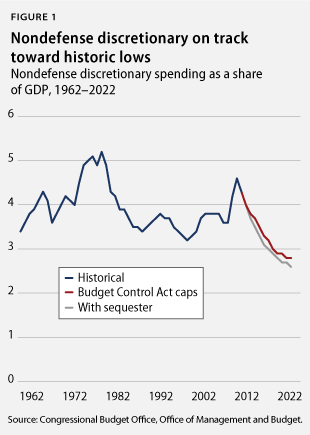
Since the start of fiscal year 2010, the official Congressional Budget Office projection of nondefense discretionary spending has fallen by more than $730 billion, a cut of more than 10 percent. Those cuts are mainly the result of legislation passed in the intervening months that dramatically curtailed federal spending in this category. Furthermore, if the additional automatic cuts known as the “sequester” remain in place the overall reduction will swell to well over $1 trillion, a 15 percent cut in total.
The very diversity and breadth of the services and programs that live under the banner of nondefense discretionary is what makes the category such a favorite target for budget cuts. The public is far more likely to accept massive cuts to a nameless collection of nebulous programs than it is to a list of specific programs that they know and like. But the effects will be the same nonetheless. We cannot cut these services down to unprecedented levels and expect there to be no impact. This issue brief offers a closer look at what nondefense discretionary spending really is and what the budget cuts will mean.
Read full analysis: Budget Cuts Set Funding Path to Historic Lows
See also:
To speak with an expert on this topic, contact Katie Peters at 202.741.6285.
###