Center for American Progress

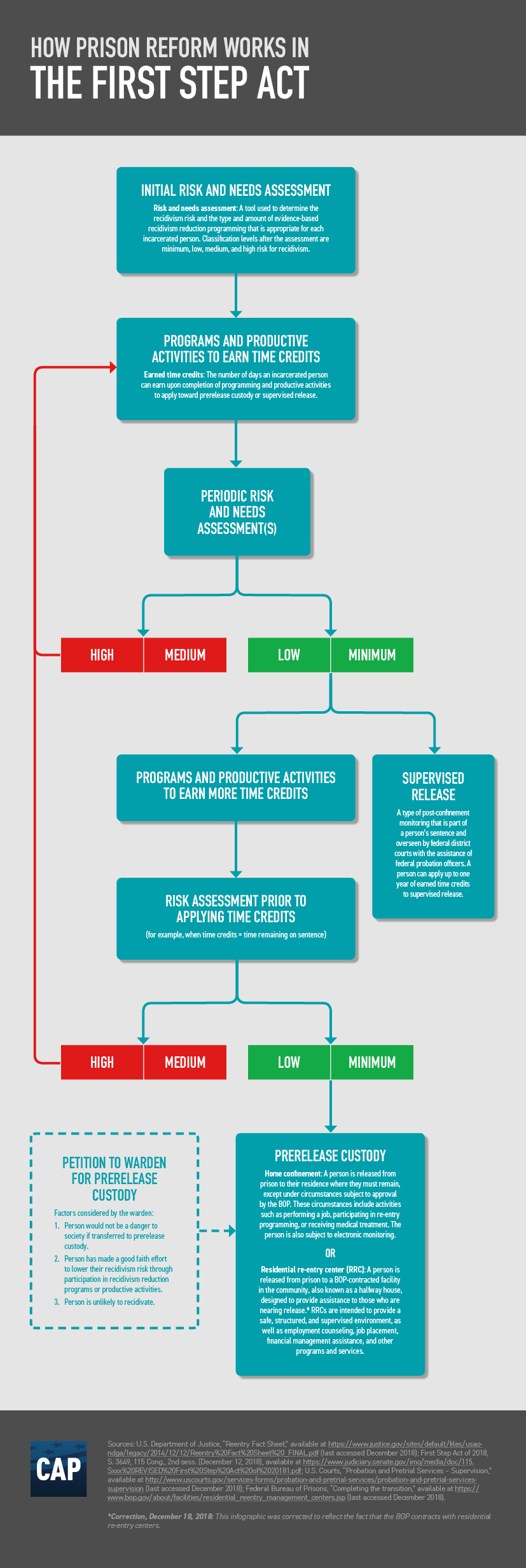
Infographic: How Prison Reform Works in the FIRST STEP Act
Article

Infographic: How Prison Reform Works in the FIRST STEP Act

This infographic serves as a visual representation of the FIRST STEP Act’s prison reform provisions.

This infographic contains a correction.

The FIRST STEP Act creates a system within the Federal Bureau of Prisons (BOP) intended to provide those incarcerated with programs, education, and skills that will help them re-enter their communities after they have served their sentence. These re-entry programs are essential public health and safety strategies, since 95 percent of those incarcerated will eventually be released and return to their families. Thus, policymakers should look to expand—rather than restrict—incentives to participate in these programs.

This infographic details how the FIRST STEP Act’s prison reform provisions work and how the multiple layers embedded in the system ensure a person receives the services and programs they need to transition back into the community.
Ed Chung is the vice president for Criminal Justice Reform at the Center for American Progress. Bill Rapp is the art director at the Center. Maritza Perez is the senior policy analyst for Criminal Justice Reform at the Center. Lea Hunter is a research assistant for Criminal Justice Reform and Race and Ethnicity Policy at the Center.

The positions of American Progress, and our policy experts, are independent, and the findings and conclusions presented are those of American Progress alone. American Progress would like to acknowledge the many generous supporters who make our work possible.

Authors

Ed Chung

Senior Fellow

Bill Rapp

Senior Director, Art

Maritza Perez

Senior Policy Analyst

Lea Hunter

Research Associate

Teams

Public Safety

Protecting people from crime is one of the government’s most fundamental and urgent responsibilities. However, the current reality is that too many crimes go unsolved and too many victims lack justice. The Center for American Progress is committed to advancing evidence-based policies that keep individuals safe by solving crime when it happens, ensuring swift and certain accountability for those who harm others, and preventing crime in the first place.